Neuroscience & Consciousness · Everyday Activation Cards
Why your brain prefers art it can't quite figure out
The neuroscience of abstract expressionism explains something that art lovers have always felt but rarely been able to name — and it turns out the effect is more precise, and more useful, than anyone imagined.
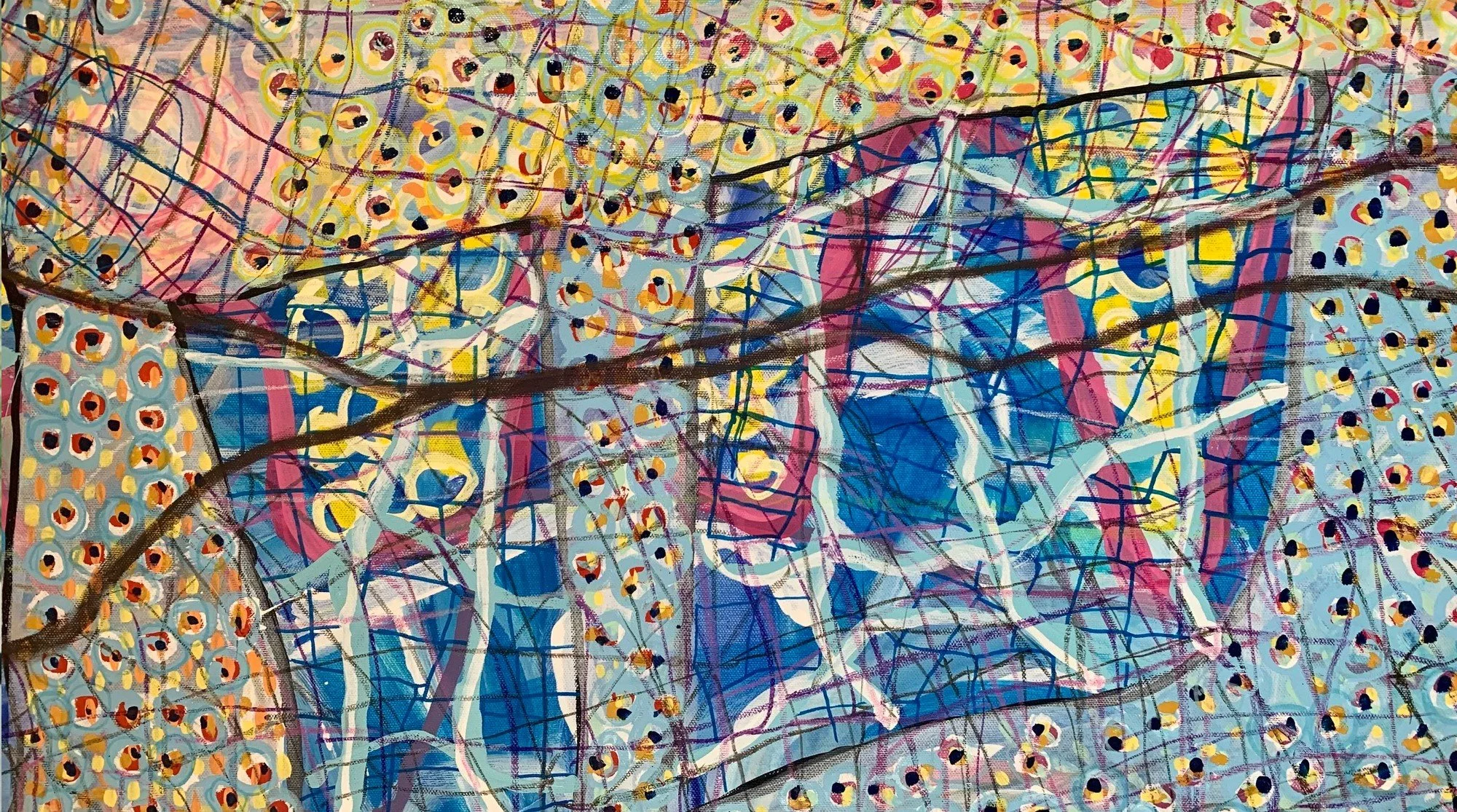
Cybele Rowe , ‘fishnets’ , 2023
There is a particular kind of attention we pay to art that we can't immediately decode. Not frustration — something closer to its opposite. A kind of open, suspended alertness, as if the mind has decided to stay a little longer because it hasn't finished yet.
Most of us have experienced this in front of a Rothko, or a de Kooning, or any painting that refuses to resolve itself into a simple, nameable thing. We stand there longer than we planned. Something is happening, even if we couldn't say exactly what.
It turns out that neuroscience can say exactly what. And what it describes is one of the most useful cognitive states a human being can access.
The brain that can't check the box
When we look at representational art — a painting of a bowl of fruit, a portrait, a landscape — something efficient and slightly disappointing happens. The brain's pattern-recognition system, anchored in the prefrontal cortex, identifies the object, confirms it, and moves on. It has, in cognitive terms, checked a box.
Abstract expressionism refuses this. Because there is no object to identify, no box to check, the brain enters what researchers call bottom-up processing — a state of active, open-ended searching in which the visual system keeps working, keeps reaching, keeps finding. The prefrontal cortex can't close the loop, so it stays engaged.
THE RESEARCH
Neuroaesthetics researcher Anjan Chatterjee at the University of Pennsylvania describes the experience of art through what he calls the Aesthetic Triad: the sensory-motor response (perceiving colour, shape, texture), the knowledge-meaning response (reaching for personal associations and context), and the emotion-valuation response (the reward system activating around what he calls "the pleasure of understanding").
With abstract expressionism, all three systems activate simultaneously — and none of them fully resolves. The result is a state of sustained, open attention that is neurologically distinct from ordinary looking.
The scientific term for what this produces is psychological distance — and it is precisely as valuable as it sounds. Research by Nira Liberman and colleagues on Construal Level Theory shows that abstract thinking shifts the mind from concrete, immediate detail to broader, higher-level concepts. The anxious mind locked in tactical thinking is gently lifted into strategic perspective. Not by instruction. By looking.
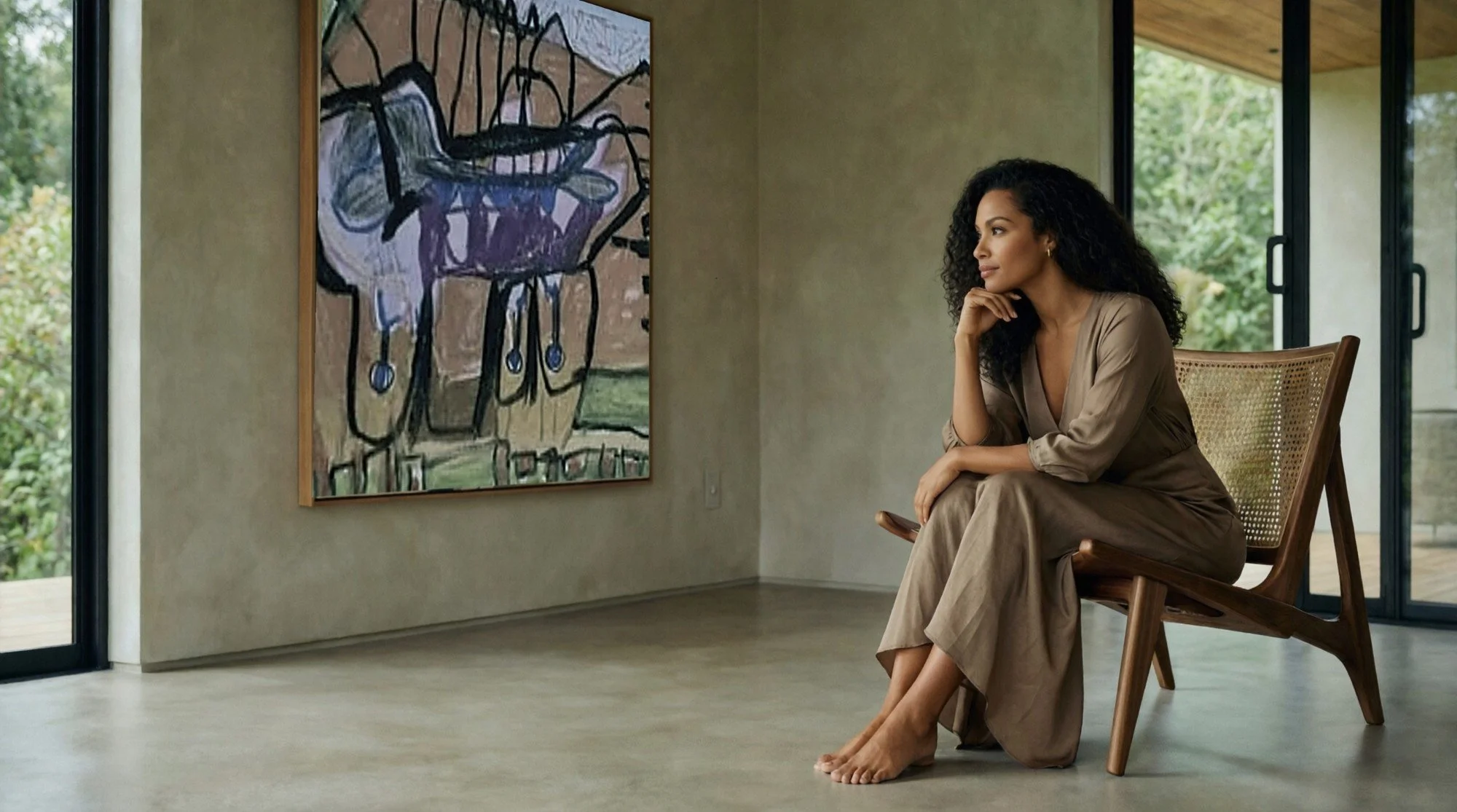
The state that abstract art produces is not passive. It is a particular kind of active stillness.
The network that switches on when you're moved
Here is where it gets interesting.
Normally, when we focus on the external world — a task, a screen, a conversation — a part of the brain called the Default Mode Network goes quiet. The DMN is the system responsible for self-reflection, for imagining the future and revisiting the past, for the inner narrative that constitutes much of what we call our inner life. Focused outward attention suppresses it.
Except, neuroscience has found, when we are genuinely moved by art.
In those moments, the DMN activates alongside the task-focused networks — simultaneously, rather than in opposition. The result is a state that researchers describe as "internally directed attention": fully present in the external experience while also deeply engaged with internal meaning-making.
"This simultaneous activation — outward and inward at once — is the neurological definition of a deep trance state. It is also, not coincidentally, what people report when they describe being 'lost in' a piece of art."
It is not a metaphor. The boundary between self and image genuinely blurs — not because the art is hallucinatory, but because the brain is doing something precise and specific: using the external image as a surface on which to project and process internal experience.
Abstract expressionism is uniquely suited to this because it offers no competing narrative. A representational painting brings its own story. Abstract work creates space for yours.
What the voice adds
Paired with skilled audio guidance, something else becomes possible.
A practitioner's voice — particularly one with training in prosody, in the rhythm and pitch of language — does something measurable to the nervous system. A calm, rhythmically consistent voice increases vagal tone: the activity of the vagus nerve, which signals the body to move from sympathetic activation (the stress state) to parasympathetic rest. Heart rate slows. Cortisol drops. The breath deepens without effort.
In this state, the voice becomes what researchers call a precision primer — it can direct the brain's internal search engine toward specific emotional states or cognitive frameworks. When that guidance arrives while the eyes are resting on abstract art, something precise happens at the intersection of the two inputs.
The Insula — the brain region that bridges visual experience and emotional interpretation — becomes the meeting point. The art is no longer just something being looked at. It becomes a visual anchor: a physical object that, through repeated association, begins to carry the emotional and cognitive state the audio induced.
Which means that every time you look at the piece afterward — on the wall of your office, your home, your studio — the nervous system remembers. Not as a thought. As a felt shift.
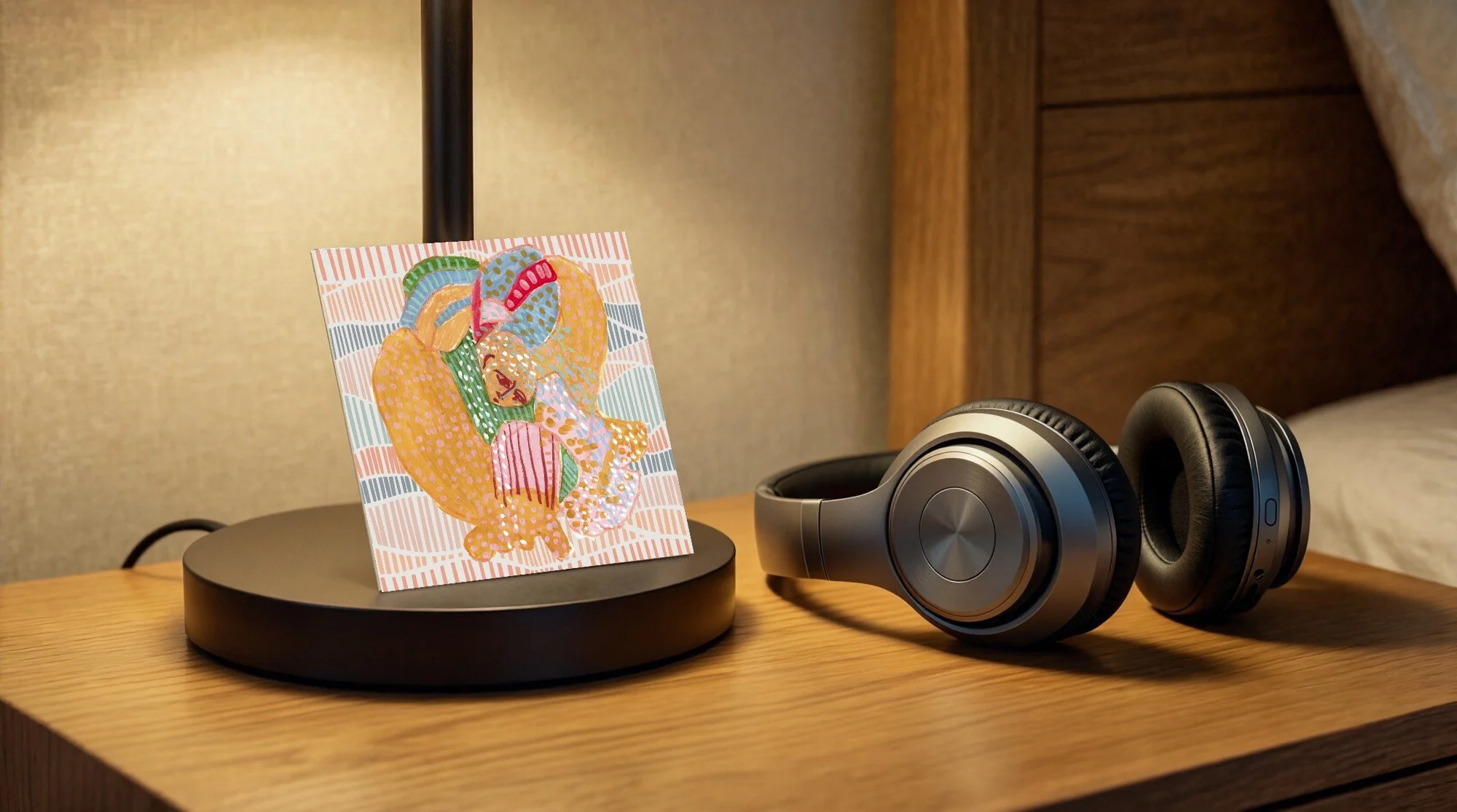
Each card carries a QR code linking to a 5–20 minute guided audio activation by Rebekah Vandenberg.
Three audiences, one circuit
What is useful about this convergence is that it speaks differently to different people — without requiring a different product.
WELLNESS
The art and audio combination activates the parasympathetic nervous system, deactivates the amygdala, and creates conditions for genuine emotional regulation and recovery.
PERFORMANCE
The state of psychological distance produced by abstract art — strategic, high-altitude thinking — is precisely what high performers need to break out of tactical lock. The visual anchor makes it repeatable on demand.
ART
The neuroscience simply names what serious engagement with art has always produced. The technology doesn't create the experience — it makes it intentional, accessible, and returnable.
The three audiences have different vocabularies for the same underlying experience. That experience is neurologically real, measurably distinct from ordinary relaxation or ordinary aesthetic appreciation, and — crucially — it can be reliably induced by the specific combination of abstract expressionist art and skilled audio guidance.
This is not a wellness claim. It is not a therapeutic claim. It is a description of what the brain does when given these two inputs together — a description that neuroscience has been building the evidence for, piece by piece, for the last two decades.
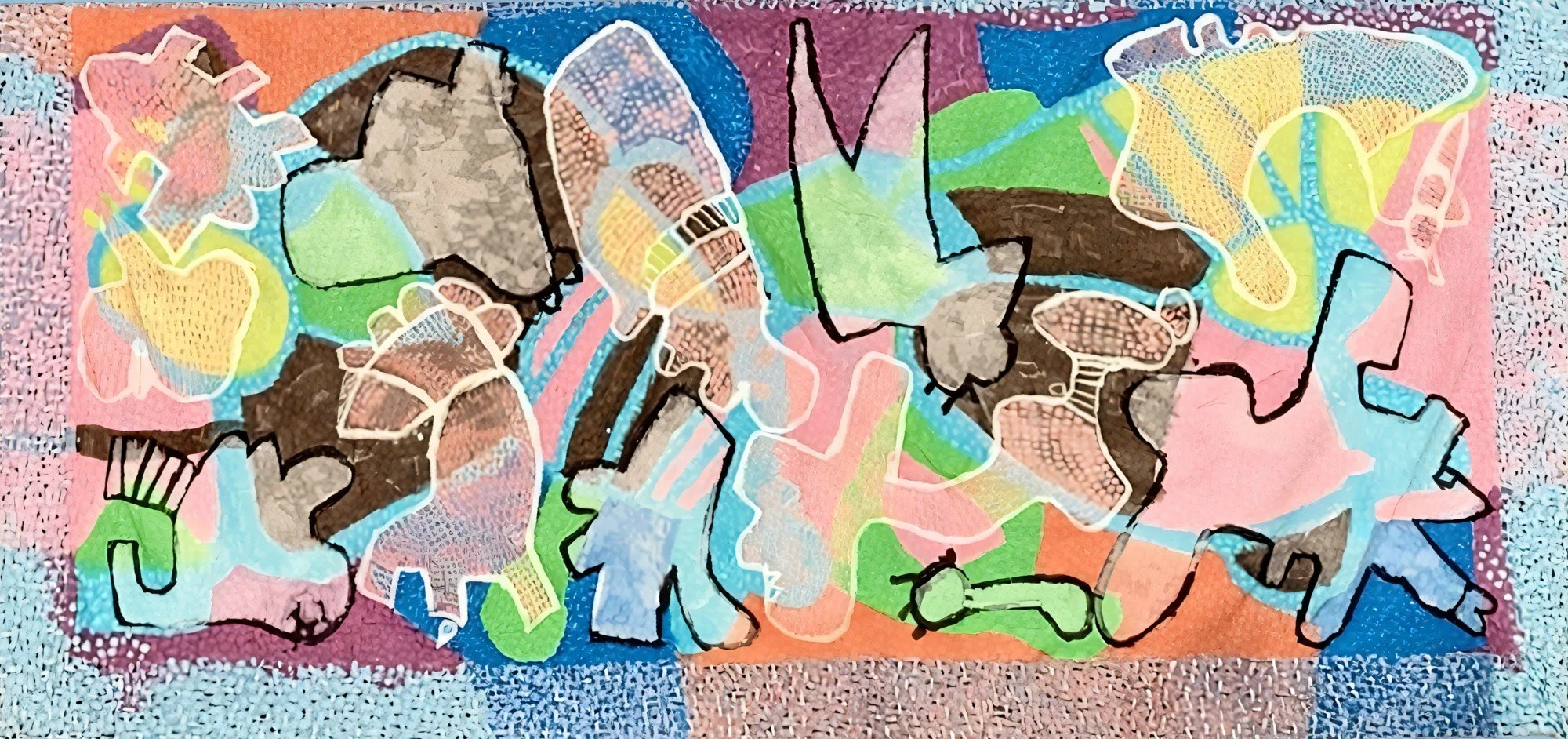
The art doesn't decorate the experience. It completes the circuit
The suspended, open attention you feel in front of art you can't quite decode — that is not a distraction from the experience. It is the experience. And it turns out it's one of the most useful things a mind can do.
Everyday Activation Cards are a collaboration between artist Cybele Rowe and voice practitioner Rebekah Vandenberg— three decks of fifteen cards, each with original fine art and a QR code linking to a guided audio activation.. Learn more →