The Border State
What happens at the edge of sleep — and why it’s the most useful place a mind can go
Neuroscience & Consciousness · Everyday Activation Cards
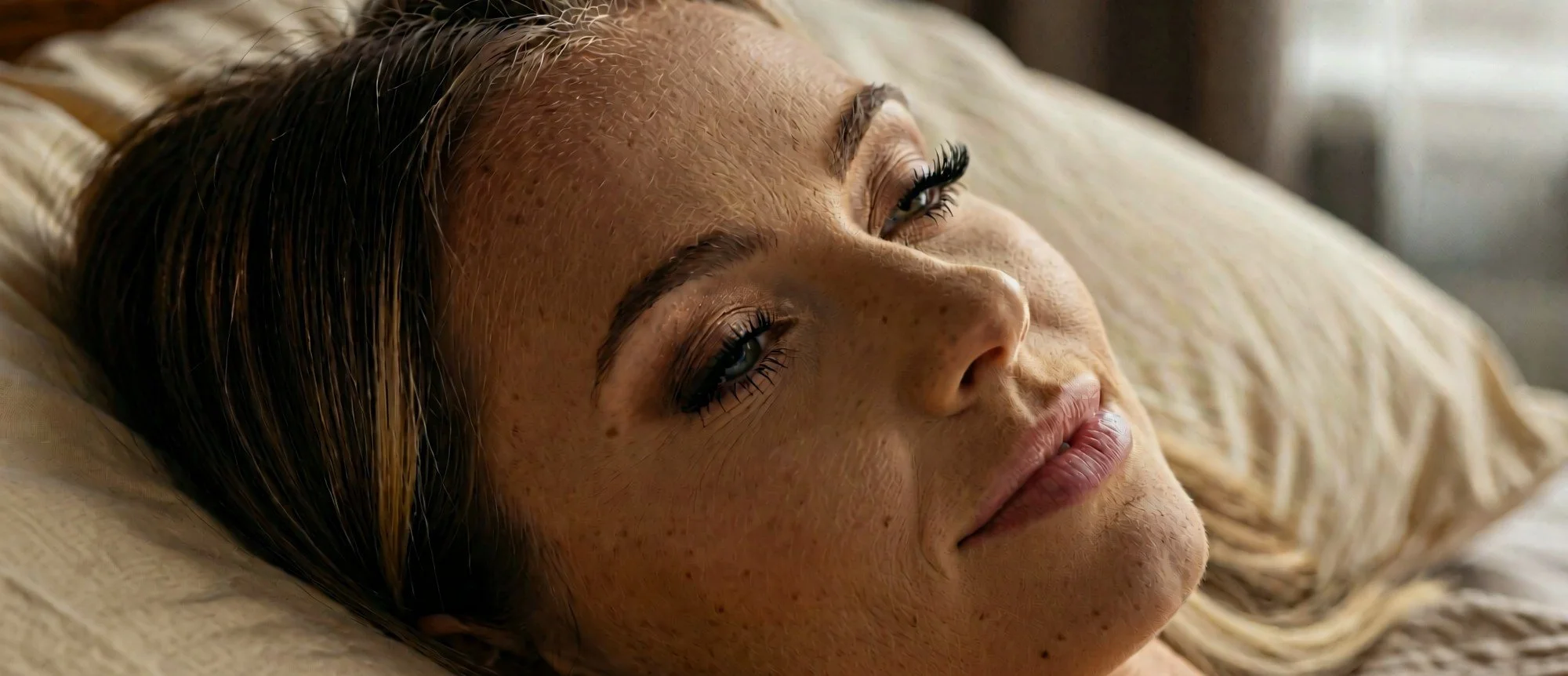
Neither awake nor asleep. Neither directed nor adrift. The brain, at this particular threshold, is doing something it cannot do anywhere else
There is a moment, familiar to almost everyone, that arrives in the minutes before sleep. The body has let go. The breath has slowed. Conscious thought has begun to loosen — images arrive without being summoned, associations form without logic, the boundary between self and surrounding softens in a way that is neither frightening nor fully voluntary.
Most of us pass through this moment on the way to somewhere else.
It turns out it is, neurologically speaking, one of the most significant states the human brain ever enters. And for most of human history — until sleep science gave it a name and measurement instruments gave it a signature — we moved through it without knowing what we were moving through.
The threshold has a name
The state between full waking alertness and sleep is called the hypnagogic state — from the Greek hypnos (sleep) and agogos (leading toward). Electroencephalogram research maps it precisely: as the brain transitions from alert beta waves through the relaxed alpha range and approaches the slower theta waves of early sleep, there is a zone — the alpha-theta border — where something neurologically unusual occurs.
In this zone, the brain is simultaneously running two modes that are ordinarily in opposition. The default mode network — the system responsible for self-reflection, imaginative processing, and the integration of experience into meaning — is active. But the executive function networks have not yet fully disengaged. The result is a state of open, associative, internally directed attention that is neither the focused cognition of wakefulness nor the unconscious processing of sleep..
THE RESEARCH — Thomas Budzynski at the University of Colorado was among the first researchers to study the alpha-theta border deliberately, beginning in the 1970s. Working with biofeedback instruments that allowed subjects to monitor their own brainwave states in real time, Budzynski found that training people to sustain the alpha-theta threshold — rather than pass through it on the way to sleep — produced measurable changes in creative problem-solving, emotional processing, and what he described as the dissolution of rigid cognitive patterns. His subjects weren’t meditating in any traditional sense. They were learning to inhabit a state the brain normally only visits in transit.
Subsequent research has deepened the picture considerably. Neuroscientist Tadas Stumbrys and colleagues at the University of Bern found that the alpha-theta border is associated with what they call hypnagogic creativity — the production of novel associations and solutions that the fully alert mind, constrained by its own existing patterns, could not generate. The surrealists knew this empirically; Salvador Dalí famously slept holding a key over a plate, waking the instant it dropped to capture the hypnagogic imagery before it dissolved. The neuroscience has simply confirmed what artists and practitioners have always exploited: the threshold state is where the fixed mind softens.
What makes it different from meditation
“Meditation typically works within the alpha range — calm, present, aware. The alpha-theta border goes further. It is where the brain’s consolidation processes relax enough to allow something genuinely new.”
This distinction matters because it is frequently misunderstood. Mindfulness meditation — in most of its mainstream forms — cultivates alert, present-moment awareness in the alpha range. That is valuable. It is also a different thing from what happens at the alpha-theta threshold.
At the threshold, the prefrontal cortex’s evaluative function — its tendency to assess, compare, and dismiss input that conflicts with established beliefs — begins to relax in ways that do not occur during ordinary meditation. The brain enters what researchers describe as a state of reduced cognitive inhibition: not impaired thinking, but thinking that is less constrained by its own existing architecture.
This is why the therapeutic and performance applications of alpha-theta work have focused on it specifically rather than on meditation more broadly. Peniston and Kulkosky’s landmark 1989 studies used alpha-theta biofeedback training with veterans experiencing post-traumatic stress — with results that led researchers to propose that the threshold state allows traumatic memory consolidation to be revisited and restructured in ways that ordinary waking therapy cannot access. The mechanism, they argued, was precisely the reduced inhibition: the brain at the threshold can form new associations with material that the alert mind has defensively walled off.
For performance applications — less charged but equally specific — the threshold state allows something similar in cognitive rather than emotional terms: the loosening of fixed mental models, the surfacing of connections that routine thinking suppresses, the brief experience of the mind as something larger and more fluid than its habitual contours suggest.
Arriving there deliberately
The challenge has always been reliability. The hypnagogic state arrives naturally for most people in the minutes before sleep — but catching it, sustaining it, and doing anything useful within it requires either biofeedback equipment or a reliable method for inducing and holding the state without sliding into unconsciousness.
This is precisely the territory that 40 years of direct practice in altered states develops. The method is not biofeedback. It is voice, breath, rhythm, and the precise use of language patterns that guide the nervous system toward the threshold without pushing it over. The art provides the external anchor — a point of open, receptive visual attention that keeps the brain in the productive zone rather than drifting into sleep. The specific qualities of abstract expressionism, as explored elsewhere in our science writing, are unusually well suited to this function: engaging enough to sustain attention, unresolved enough not to trigger the pattern-recognition that would pull the brain back toward full alertness.

The art holds the threshold open. The voice does the work within it.
The alpha-theta border is not mystical. It is a specific, measurable, reliably inducible neurological state — one that the brain enters naturally every night and that deliberate practice can make available during the day. What changes when you can reach it intentionally is not the state itself. It is what you can do while you’re there.
The Science page on our site introduces the research behind each element of Everyday Activation Cards. This post goes deeper on the alpha-theta threshold — the governing state at the heart of the methodology.
Everyday Activation Cards is a collaboration between artist Cybele Rowe and consciousness practitioner Rebekah Vandenberg.
Three decks. Forty-five activations. Learn more →