Forty Years in the Dark
Neuroscience & Consciousness · Everyday Activation Cards
What Deep Trance Technology™ is, where it came from, and why a methodology built from direct practice is different from one assembled from research

The methodology was not assembled. It was discovered — slowly, over decades, in direct practice.
There is a particular kind of knowledge that cannot be obtained from research. It can be informed by research, confirmed by research, given language by research — but it cannot be derived from it. It comes only from sustained, direct, repeated practice in the territory itself: from going into the altered state thousands of times, from guiding others through it tens of thousands of times, from learning what the body does and what the voice does and what the silence between words does by being present for it, over and over, for years that become decades.
Deep Trance Technology™ is that kind of knowledge.
It is a methodology built from 40 years of direct practice in altered states, consciousness work, and the transformative use of voice. It is not a framework borrowed from an existing school. It is not an application of clinical hypnotherapy or mindfulness-based stress reduction or any other named modality, though it has been informed by all of them and by the research traditions they have generated. It is something more specific and, in some ways, more fundamental: a rigorously developed understanding of how human beings change at depth — and what it takes to reliably take them there.
What a methodology built from practice looks like
Most wellness and therapeutic modalities are built in one of two ways. They are either research-derived — developed in laboratory or clinical settings, tested against control conditions, refined through peer review — or they are tradition-derived, emerging from established lineages of practice (Buddhist meditation, Indigenous healing traditions, yogic systems) that carry their own accumulated evidence in the form of centuries of practical wisdom.
Deep Trance Technology™ is neither of these, though it draws on both. It is practitioner-derived — built from the inside out, from the experience of what actually happens when a trained voice meets a human nervous system in a state of genuine altered attention.
What 40 years accumulates The difference between a practitioner with two years of experience and one with 40 is not primarily knowledge of technique. It is pattern recognition at a level that cannot be taught — the ability to read, in real time, the quality of someone’s breath, the micro-shifts in their body language, the slight changes in their vocal response, and to know from these signals precisely where they are in the altered state and what the voice needs to do next. This is not information that can be transmitted in a training programme. It is embodied, accumulated, and inseparable from the person who carries it.
It is also the quality that makes the audio activations work at the level they do. A recorded activation by a practitioner of this depth is not simply a script read well. It is a precisely calibrated acoustic environment built from decades of knowing — knowing what the nervous system needs at each stage of descent, knowing how the voice must change as the listener goes deeper, knowing when to move and when to wait and when the silence is doing more than anything that could be said.
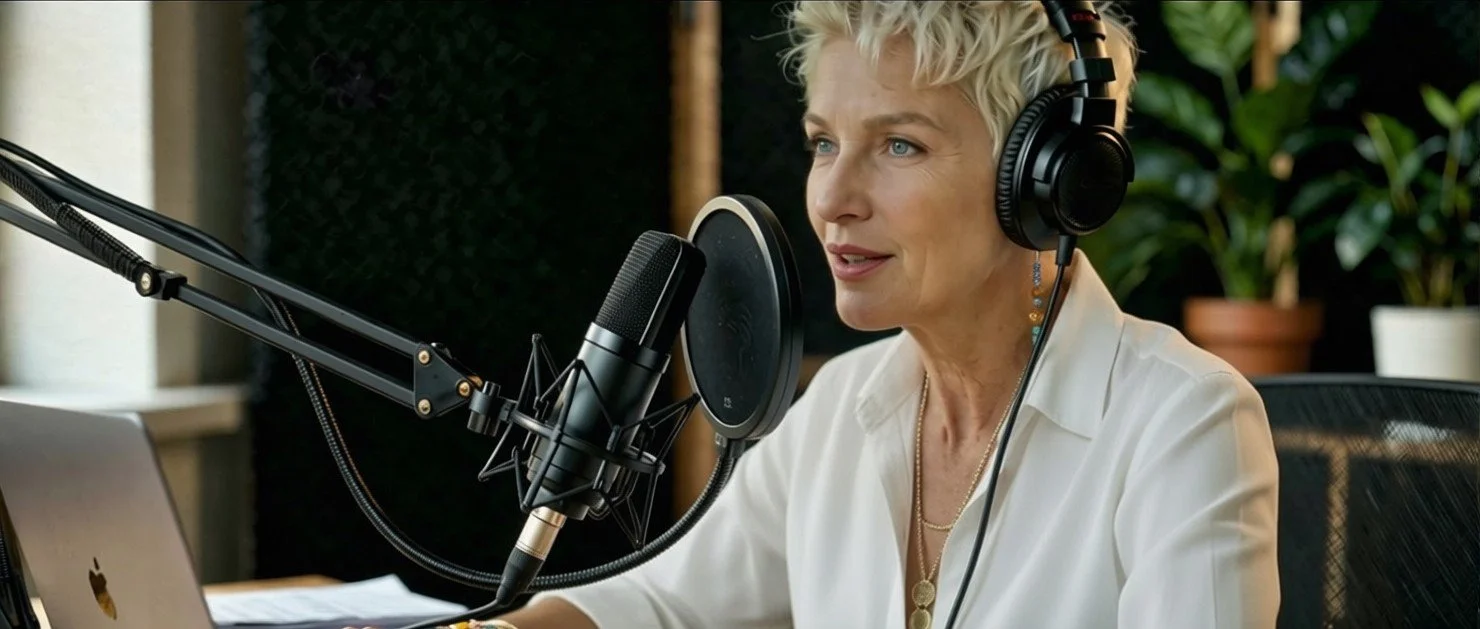
Rebekah Vandenberg has been working in altered states and consciousness practice for over 40 years.
The specific territory
Deep Trance Technology™ works in a specific zone: the alpha-theta border state, described elsewhere in our science writing — the threshold between waking alertness and sleep where the brain’s neuroplastic flexibility is at its highest and where the fixed patterns of ordinary cognition become briefly fluid.
The methodology’s approach to this territory has several specific characteristics that distinguish it from adjacent practices:
Voice as the primary instrument, not a delivery mechanism In most guided meditations and therapeutic hypnosis applications, the voice is understood as a vehicle for content — the words are the intervention, the voice is the delivery. DTT inverts this. The voice itself is the primary therapeutic instrument. Its prosody, rhythm, resonance, and breath are doing work that the words cannot do — work that operates below the level of semantic comprehension, directly on the nervous system. The words matter, but they matter within an acoustic environment that the voice has already created.
The body before the mind DTT consistently begins with the body rather than the mind — with breath, with sensation, with the physical experience of weight and release — before moving into imagery or directed internal experience. This sequencing is deliberate and neurologically grounded: the nervous system must be regulated at the physiological level before the brain’s higher-order processing can be usefully reached. Attempting to access deep cognitive or emotional material in a dysregulated nervous system produces resistance or dissociation rather than genuine change.
Specificity over generality Each activation in the Everyday Activation Cards system addresses a specific territory — not “relaxation” but Ocean, not “confidence” but The Warrior Within, not “love” but Real Love or Divine Love or Life Force of Love, each a distinct experiential address. This specificity is not branding. It is methodological. The brain forms stronger, more accessible associations around specific, richly textured experiences than around general states. The more particular the journey, the more reliably the anchor holds.
What it is not
“Deep Trance Technology™ is not hypnotherapy, though it uses some of the same neural mechanisms. It is not meditation, though it produces some of the same neurological outcomes. It is not shamanic practice, though it draws on similar understandings of altered states and consciousness. It is something that emerged from serious engagement with all of these traditions — and with 40 years of direct practice in the territory itself.”
This distinction matters because each of those adjacent practices carries associations that may or may not apply — and some that actively mislead. The word “trance” in particular tends to trigger either clinical associations (therapeutic hypnosis, dissociation) or theatrical ones (stage hypnosis, the surrender of agency). DTT works with neither model. The altered state it induces is one of heightened, not diminished, inner awareness — a state in which the ordinary noise of surface cognition quiets sufficiently for something more fundamental to become accessible.
The person in a DTT activation is not passive. They are active in a different register — below the level of deliberate thought, in the domain of felt experience, embodied intelligence, and the deeper processing that ordinary waking life rarely creates conditions for..
Why it matters for the cards
The audio activations in Everyday Activation Cards are not produced content. They are not scripts read into a microphone by someone with a pleasant voice. They are the direct output of this methodology — specific, precise, built from decades of knowing exactly what the voice must do at each moment of a journey into the altered state and back.
This is what makes EAC methodologically distinct from the large and growing market of wellness audio products. The science of what the voice does — detailed in our Series I posts on prosody and the vagus nerve — explains the mechanism. The methodology explains why the execution is what it is. And the 40 years explains why no amount of research reading can replicate it.

Each activation carries 40 years of direct practice in altered states. The QR code is the door.
The Science page on our site introduces the research behind each element of Everyday Activation Cards. This post goes deeper on the alpha-theta threshold — the governing state at the heart of the methodology.
Everyday Activation Cards is a collaboration between artist Cybele Rowe and consciousness practitioner Rebekah Vandenberg.
Three decks. Forty-five activations. Learn more →