Neuroscience & Consciousness · Everyday Activation Cards
You've been chasing flow state wrong
Every high performer knows the feeling: an hour that contains more real work than an entire anxious day. Neuroscience now knows exactly what produces it — and why almost everything we do to chase it pushes it further away.
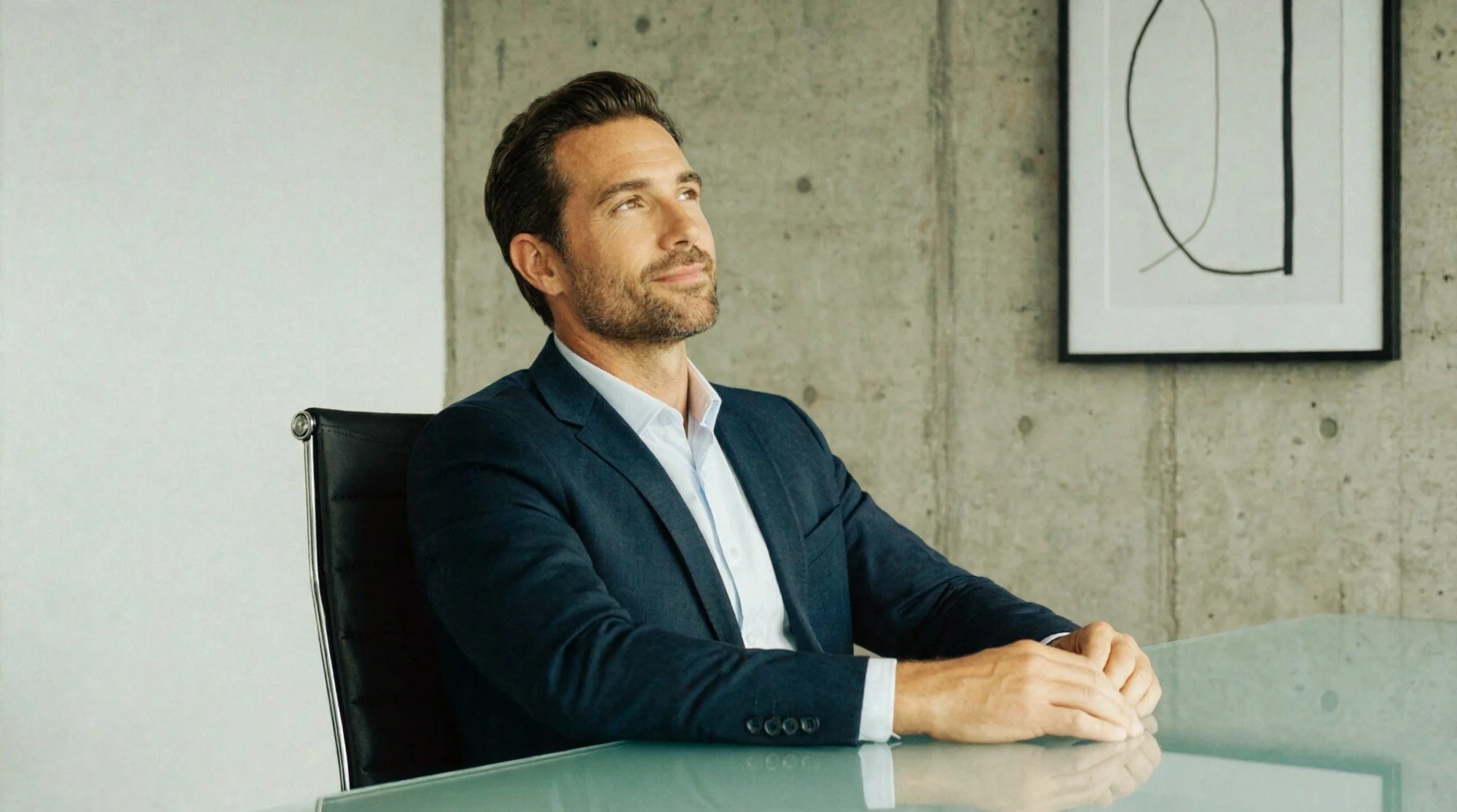
Flow doesn't respond to effort. It responds to conditions.
Mihaly Csikszentmihalyi spent decades studying the state he named flow — the experience of being so completely absorbed in an activity that time distorts, self-consciousness dissolves, and performance rises to levels that feel almost effortless. Athletes call it being in the zone. Musicians call it being in the pocket. Executives who've felt it once spend years trying to find their way back.
Most of them are looking in entirely the wrong place.
The reason is this: flow is not a state you enter by trying harder. It is a state that emerges when a specific set of neurological conditions are met — conditions that effort and striving actively work against. Understanding what those conditions actually are changes everything about how you approach your most important work.
The network behind the experience
To understand flow, you need to understand a part of the brain that most productivity culture ignores almost entirely: the Default Mode Network.
The DMN is the constellation of brain regions that activates when you are not focused on an external task — when you are daydreaming, reflecting, imagining the future, or processing the emotional texture of your own experience. For a long time neuroscientists considered it a kind of background noise: the brain idling between tasks. That view turned out to be profoundly wrong.
The DMN is now understood to be the seat of some of the brain's most sophisticated processing — the integration of experience into meaning, the projection of past knowledge onto future scenarios, the construction of what we might call the narrative self. It is not idle. It is doing something essential, and it is doing it quietly, beneath the surface of focused attention.
THE RESEARCH
Under normal conditions, the DMN and the task-positive network — the system that activates during focused, goal-directed work — operate in opposition. When one is active, the other suppresses. This is why your best ideas arrive in the shower: the moment focused attention relaxes, the DMN comes online and surfaces the connections it has been quietly assembling.
Flow state, neuroimaging studies have found, is characterised by something unusual: both networks activating simultaneously. The focused attention of the task-positive network and the integrative, meaning-making activity of the DMN working in concert rather than in opposition. The result is a cognitive state that is both sharply directed and richly connected — which is precisely why flow produces work that feels simultaneously effortless and inspired.
This is the neurological reality behind the experience of flow. And it immediately explains why chasing it rarely works.
Why effort is the enemy
When we are anxious about performance — when we are trying, monitoring, evaluating — we are operating deep in the task-positive network, with the DMN firmly suppressed. We are focused, yes. But we are focused in a way that shuts down exactly the integrative, associative processing that makes flow possible.
This is what athletes mean when they talk about overthinking a performance. The trying is the problem. The self-monitoring is the problem. The very act of attempting to enter flow is, neurologically, what prevents it.
"Flow doesn't respond to effort. It responds to conditions. Specifically, it requires the nervous system to be calm enough, and the mind open enough, that the DMN and the task-positive network can find each other."
Those conditions are not mysterious. They are not the result of years of meditation practice, though meditation can help create them. They are, at root, a question of moving the nervous system from a state of high-alert sympathetic activation into a state of calm, alert readiness — and then providing the mind with something genuinely engaging to rest on before the work begins.
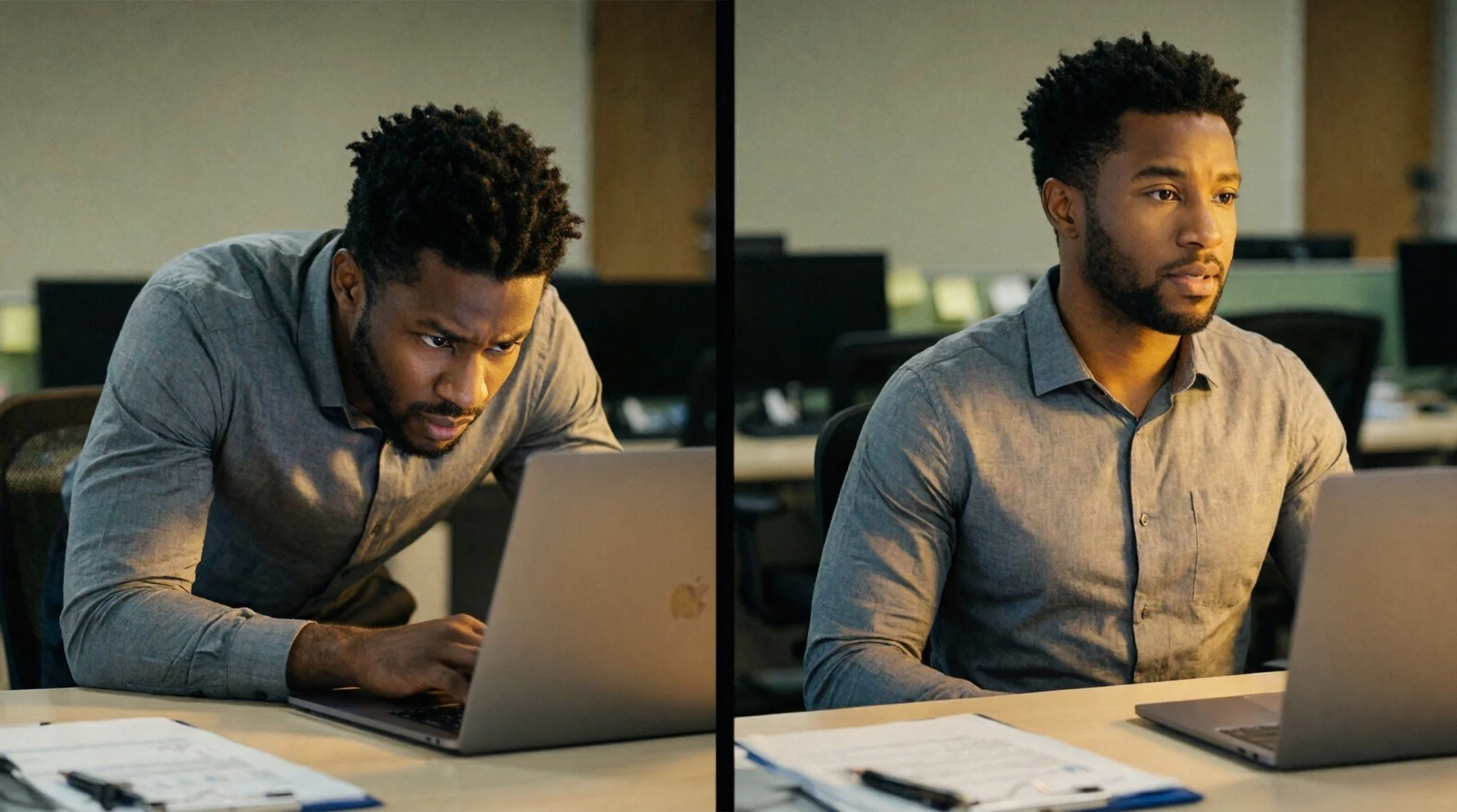
The nervous system knows the difference between focused and braced.
What the brain actually needs
Creating the conditions for flow requires three things in sequence — and this sequence matters.
Nervous system downregulation The sympathetic nervous system — the fight-or-flight system — must be brought down from its habitual baseline. Not into drowsiness. Into calm alertness. This requires something that acts directly on the vagus nerve: rhythmic breathing, a steady and unhurried voice, a reduction in the rapid-fire sensory demands that keep the system elevated. The body has to believe, at a physiological level, that the emergency is over.
Cognitive decoupling from immediate concerns The prefrontal cortex needs to step back from the immediate, tactical concerns that consume it during ordinary working attention. This is what researchers call psychological distance — a shift from concrete, close-focus thinking to the more expansive, abstract mode associated with the DMN. It cannot be willed. It can, however, be invited — by giving the mind something genuinely absorbing that operates at the level of pattern, feeling, and association rather than fact and task.
A transition object The brain benefits from something external that holds the quality of the state being approached — a stable, non-demanding point of focus that the nervous system can use as a reference point as it settles. In meditation traditions this is often a candle flame, a mantra, or the breath itself. The key property is that it should be engaging enough to anchor attention, simple enough not to trigger analysis, and rich enough to sustain open, receptive looking.
Each of these conditions can be created deliberately. The third one, in particular, is where something interesting becomes possible.
The anchor that travels
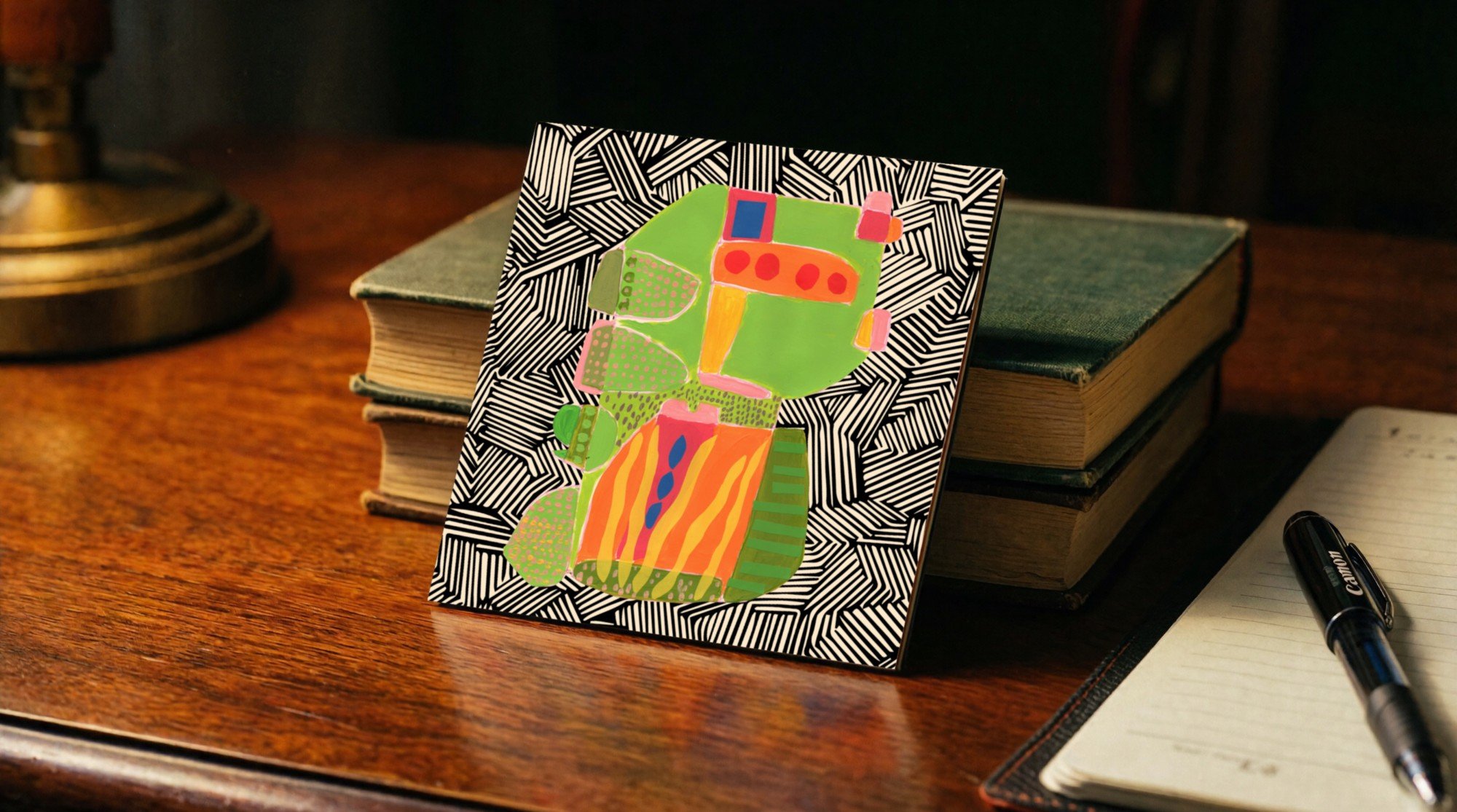
The card becomes a physical anchor for a state the brain knows how to return to.
Abstract expressionist art, as we explored in the previous piece in this series, produces a specific cognitive state: sustained, open-ended attention that activates the DMN while keeping the visual system engaged. It creates exactly the quality of receptive looking that the third condition requires — without demanding analysis, without offering easy resolution, without triggering the pattern-recognition shutdown that representational art produces.
But there is something more that happens when art is paired with guided audio — specifically, with the kind of voice-led activation that works directly on the nervous system through rhythm, prosody, and directed internal attention.
The brain forms associations. When a state of calm, open, integrated attention is induced — reliably, repeatedly — in the presence of a specific visual object, that object begins to carry the state. Not as a memory. As a felt response. The visual cortex, the insula, and the autonomic nervous system have been conditioned together, and the sight of the familiar image begins to re-create the conditions that produced the experience.
Researchers call this visual anchoring. Athletes and performance coaches have long worked with versions of it. What makes a physical art object unusual as an anchor is its permanence and its presence: it lives on the wall of your office or your home, available at a glance, not requiring a phone or headphones or a quiet room. You can use it for thirty seconds before a difficult meeting. You can let it work on you across a room while you think.
A protocol, not a practice
What this points toward is something that can be structured — not as a vague instruction to "meditate more," but as a specific pre-performance protocol with a clear neurological rationale.
01
THE ANCHOR
Eyes open on the art. Guided rhythmic breathing. Two to three minutes. Nervous system begins to downregulate; visual attention settles.
02
THE DIVE
Eyes close. The voice leads inward. Ten to fifteen minutes. DMN activates; the brain moves into integrative, associative processing.
03
THE LOCK
Eyes return to the art. One to two minutes of open, quiet looking. The state is associated with the image. The anchor is set.
This is not a meditation practice in the traditional sense. It is closer to what sports psychologists call a pre-performance routine — a reliable sequence that creates the neurological conditions for the state you want to be in, rather than hoping that state will arrive on its own.
The difference is that most pre-performance routines work only at the level of behaviour and habit. This one works at the level of the nervous system — and it leaves a physical object in your environment that continues to do work long after the headphones come off.
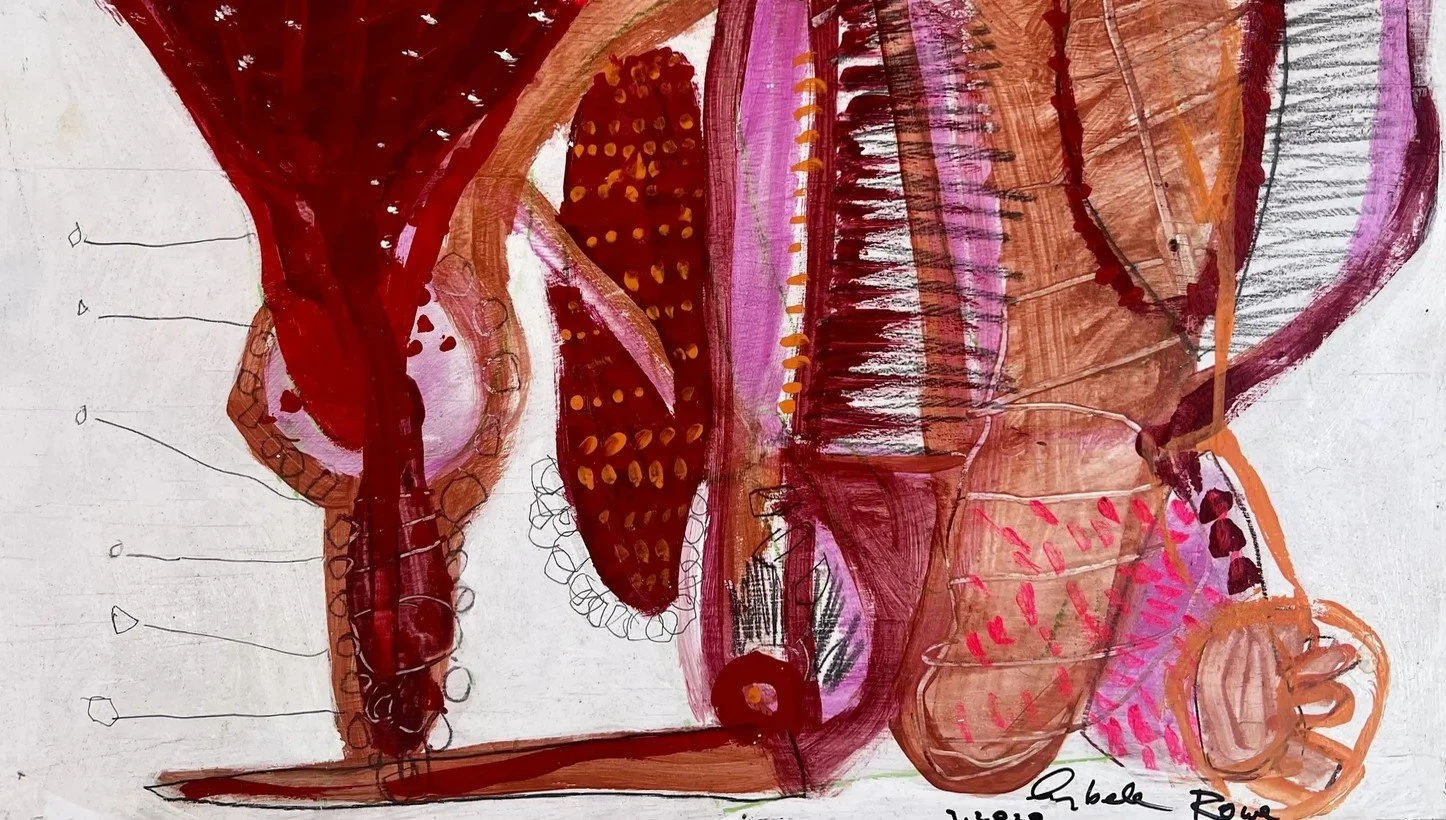
red, Cybele Rowe. [acrylic, 2024.]
Flow has always been available. The brain already knows how to produce it — it has been doing so accidentally, in the right conditions, your entire life. What changes when you understand the neuroscience is not the destination but the route: from hoping to arrive, to knowing how to get there.
This is the second in a series of posts exploring the neuroscience behind Everyday Activation Cards — a collaboration between artist Cybele Rowe and voice practitioner Rebekah Vandenberg.
Read the first post: Why your brain prefers art it can't quite figure out →